Museums are intriguing places to visit, not just because of what they contain, but also because of how they weave a story together with what they contain. You can tell a lot about a place just by how their museums tell their national story. On Saturday, we visited the Israeli Museum here in Jerusalem. The most important part of the museum is dedicated to the various ancient scrolls and codices (books) that are the foundation of the Old Testament. In other words, they ground the religious and historical identity of Israel as a nation.
However, I spent most of my time in the fine arts wing, which is on the same campus. Most of the exhibits did not focus on the history of Western art (as we are used to in the US), but on Israeli identity. What does it mean to be an Israeli? What does it mean to be a Jewish nation? It was a fascinating question that was answered in various ways through different works of art. Yet, I think that this question was answered later in the day as I walked down the main street of downtown Jerusalem during Shabbat.
Shabbat, or Sabbath, is observed from sundown Friday to sundown on Saturday. During this time everything in Jerusalem shuts down and the streets are nearly free of cars. Everyone is walking and a silence ensues. To see a normally bustling main street filled with trendy shops, upscale cafe's totally closed, and silence permeating the urban ambiance is something an American is not used to. The observance of the commandments and laws of Moses are what seem to give this city its identity. This may seem obvious to some, since Jerusalem is the center of religious life for Jews around the world, however, to see it lived concretely is a completely different thing.
Having the Sabbath not on a Sunday and being surrounded by an observant Jewish culture is a little disorienting. It is perhaps just as disorienting as the streets in the Old City (within the walls). Yet, as a Christian, I can't help but think that there is a connection to this culture, to these people. There is a unity of the rhythm of life and a unity of heart. When I see observant Jews praying at the Western Wall or observing Shabbat, I feel like a child again. It is like looking at my parents while they talk to each other and converse, and even if I don't understand everything they're talking about, I feel that I am a part of them in some way.
Tuesday, February 23, 2016

Saturday, February 20, 2016
The Way of the Cross in Jerusalem
Every
Friday during Lent hundreds of pilgrims gather to retrace the last steps of
Christ.This Friday about 15 of us joined the throng of people who would
meander through the streets of the Old City of Jerusalem, reliving the path
Christ took to his death. For over 500 years now, the Franciscan friars have
been in charge of leading this procession. We arrived at Station 1 early to see
just a handful of people who were beginning to gather. But it didn't take long
before the plaza became full, full of people from literally all over the world.
I saw Portuguese, Polish, Filipinos, Nigerians, Irish, Mexicans and even some
Californians, and those were just some of the languages I heard or flags I saw.
Also mixed in were men and women from the religious orders. The largest group
by far were the Franciscans in their brown habits, but I also saw
many different women orders, such as Mother Teresa's order, the Missionaries of
Charity in their distinctive white and blue habits. Then promptly at 3
pm the Stations of the Cross began, starting in the location where the
Roman Governor Pontius Pilate condemned Christ to death. From there we made our
way through the narrow and crowded streets of the Old City going station by
station, praying and calling to mind the Passion of Our Lord. Recalling His
falls, the forced help of Simon the Cyrene, the blows from the soldiers and the
loving gaze of His Mother.


Eventually we made our way to the final stations
which reside in the Church of the Holy Sepulcher, an absolutely huge church
built over the location where Christ was crucified and laid in the tomb. The
whole procession was quite the experience, because most of the time I had no
idea what was going on, the prayers were in Arabic and Latin for the most part,
sometimes I wasn't sure which of the fourteen Stations we were at, and
sometimes you would get separated from the group and would have to scramble
just to get back into the procession. Besides the surface level confusion I was
experiencing, it was beautiful and amazing to see so many people from every
corner of the world coming together, united in their prayer and love for the
God man who died for them. Strangers in a foreign land, but walking together in
the same direction because of an event that happened 2,000 years ago. Every
single one of us, carrying our own unique crosses but still full of hope
because we know His death leads to our salvation. It was a powerful experience,
one of the blessings of being in the Holy Land for an extended period. So, if
you happen to find yourself at your local parish's Stations of the Cross next Friday,
know that in the streets of Jerusalem hundreds of people will be in solidarity
with you.

Friday, February 19, 2016
[Early] Mass at Calvary
An early morning rise! That was how this beautiful day met our eyes. And, bearing in mind the numbers of the pilgrims that stream into the Holy Sepulchre each day, That made perfect sense!
Luke, Matt, Andy and Clay, all of us, along with other brothers and sisters while it was still dark, went rushing into the Holy Sepulchre early in the day; and like the women from Galilee where we had spent the last days, hearts full of spices and perfumes prepared, found to our joy and amazement that the stone had been rolled away! Overfilled with joy we recalled what He said, that this Temple he will destroy and rebuild in three days;
That made perfect sense!
With delighted hearts we ran into the Holy Sepulchre and behold men with dazzling garments in His persona they came, in red robes they led us into worship and praise of the Risen Lord, an encounter to remind us of our faith, that in life and death in the Lord we remain. Fr. Duran the main celebrant with Fr. Fuller on his flank, Fr. Lodge to us the glad tidings he relayed, what St. Paul had preached to the Jews and gentiles that with the Resurrection of Christ the Cross we’ve embraced and;
That made perfect sense!
We left with joyful hearts, the Lord, having tasted and seen, his words we heard that no snoring could cease, Go forth with zeal to glorify the Lord, with our lives proclaim to the many we see, that whose side they did pierce and spit on his face, many are coming from Mundelein yearly to kiss and embrace, I ask Oh pilgrim, why spring and not fall; soon many amongst us in his persona will proclaim;
That made perfect sense!
As for the rest of the day the streets of Jerusalem we trod, site to site with curious and willing hearts we seek, from cafeterias and walkways to ice-cream parlors they probe, "Where are you from?" Inquisitively they ask, from Mundelein we say, but at the same time wonder, the delight and bliss that their faces convey.
That doesn’t make sense!
But as the evening comes and the day is about to rest, after the evening prayer when everyone is about to ingest, I think of the day and how blessed we have been, I have no words to express but to Fr. Lodge I beckon, tomorrow he says, first day in class with grace;
That will make perfect sense!
Luke, Matt, Andy and Clay, all of us, along with other brothers and sisters while it was still dark, went rushing into the Holy Sepulchre early in the day; and like the women from Galilee where we had spent the last days, hearts full of spices and perfumes prepared, found to our joy and amazement that the stone had been rolled away! Overfilled with joy we recalled what He said, that this Temple he will destroy and rebuild in three days;
That made perfect sense!
With delighted hearts we ran into the Holy Sepulchre and behold men with dazzling garments in His persona they came, in red robes they led us into worship and praise of the Risen Lord, an encounter to remind us of our faith, that in life and death in the Lord we remain. Fr. Duran the main celebrant with Fr. Fuller on his flank, Fr. Lodge to us the glad tidings he relayed, what St. Paul had preached to the Jews and gentiles that with the Resurrection of Christ the Cross we’ve embraced and;
That made perfect sense!
We left with joyful hearts, the Lord, having tasted and seen, his words we heard that no snoring could cease, Go forth with zeal to glorify the Lord, with our lives proclaim to the many we see, that whose side they did pierce and spit on his face, many are coming from Mundelein yearly to kiss and embrace, I ask Oh pilgrim, why spring and not fall; soon many amongst us in his persona will proclaim;
That made perfect sense!
As for the rest of the day the streets of Jerusalem we trod, site to site with curious and willing hearts we seek, from cafeterias and walkways to ice-cream parlors they probe, "Where are you from?" Inquisitively they ask, from Mundelein we say, but at the same time wonder, the delight and bliss that their faces convey.
That doesn’t make sense!
But as the evening comes and the day is about to rest, after the evening prayer when everyone is about to ingest, I think of the day and how blessed we have been, I have no words to express but to Fr. Lodge I beckon, tomorrow he says, first day in class with grace;
That will make perfect sense!
The House of Saint Peter
The Home of St Peter
Today we had the opportunity to visit Capernaum and have mass in a church that was built right over the ruins of St. Peter’s house. As scripture tells us, after Jesus left Nazareth he came to the region of Galilee and began to call his disciples. Most notably of these was Simon, son of John, whom he would later call Peter and give him the keys to heaven. Peter’s house has special meaning for Christians because of the many miracles performed in Capernaum. So, much meaning that one translation of the name of Capernaum is The Village of Consolations. The two miracles that I reflected upon are the curing of Simon Peter’s mother-in-law, and the curing of the paralytic.
Not many people knew of Jesus when he arrived in Galilee, but after he cured Simon Peter’s mother-in-law people flocked to his house in order that they too may be healed. The house is rather small and unassuming, yet it was no match for the faith of some people. We know that the friends of the paralytic could not get him inside because of the crowds, so they broke through the roof and lowered him down. What we don’t realize is that this roof was not made of sticks and straw, or any other flimsy material. There are seven layers of cement, each thirty centimeters thick, placed over each other to prevent any water from leaking through. This was not a simple task for those friends to accomplish, nor was is it a simple “Thank you for healing our friend, we’ll be on our way!” Once the roof was damaged, it was not reparable, but had to be torn down and rebuilt anew. This was the faith they had in Jesus, and the love they had for their friend. Could we say we have the same devotion ourselves? The house that saw such faith and love later became a holy place for early Christianity and had a church built around the house. It became a house of prayer for Christians who could not openly practice their faith.
Next to this house there is a first century synagogue floor upon which we believe Jesus taught and performed other signs and wonders. It is here in Capernaum that Jesus dwelt and lived. This place became Jesus’s city and is now a reminder of how important our faith should be. Let no obstacle stop us from reaching out to Jesus in our time of need, no matter how many layers there may be, always push through for our Lord is always waiting to heal us.
Thursday, February 18, 2016
Breaking the Cycle

Today we visited the Mount of Beatitudes and were given a couple of hours to spend in silent reflection. During Father’s homily at Mass, he offered us an insight on the beatitudes that I would like to share. Father told us that The Beatitudes (Matthew 5:1-11) were not prescriptions: “do this, and you will receive that,” but instead they described that, as Christians, we are blessed. I left mass a bit confused as to what he meant. As I pondered on what he had said, during my time in reflection, what came to mind was the following insight: that the Beatitudes are cycles of love which undo the cycles of sin. When, as broken human beings, we fall into sin, the evil one jumps on the opportunity to make us feel guilty, ashamed, and sometimes he fools us into believing that what we have done is so bad, we are rendered unforgivable. Believing ourselves unforgivable, we are discouraged to keep fighting against sin and temptations, we are weak and fall into sin again; and so the cycle of sin and death begins. Here is where the cycles of love, The Beatitudes, undo the cycle of sin.
They are not prescriptions, like I mentioned earlier. Sometimes, when we are deep in the cycle of sin, we don't have the charity needed to be merciful, or we don’t have the purity of heart we need to “see God” in others or events. So, how do they undo the cycle of sin? Well, the answer is in what Father told us; we must first realize that the Beatitudes describe that we are blessed. We are blessed because we have been shown mercy first by God, and so encouraged by His to mercy to us, by the joy it brings us, we come to see how blessed we are and from there a desire grows in us to become instruments of mercy to others. We are called “sons of God” by virtue of our Baptism, and so inspired by that love that God has for us, we seek to make peace. We know that our Heavenly Father is always ready to comfort us, we are inspired to comfort others, and thus inspire others to comfort us as well.
With all of this in mind, I ponder a very real and current situation today where we find two parties deep in the a cycle of violence, a cycle of sin: Israel and Palestine. Both sides have their rights, have their dignity, and are both important in the eyes of God. So, how can these two parties apply the Beatitudes to break this vicious cycle they find themselves trapped in? Maybe the answer lies in the youth and new generations who possibly find themselves further away from the initial days this vicious cycle began, recognizing the need for peace, for mercy, to bring an end to the pain that this war has caused their generation and hopefully seek to somehow be reconciled with their enemies. The answer is a tough one to come to, but as St. Paul once said, “where sin abides, grace abounds all the more” and so we hope that somehow the cycles of love may always triumph over sin whether in our own hearts or here in the Holy Land.
Tuesday, February 16, 2016
Magdala, Dan, and Caesarea Phillipi.
Today we visited Magdala (the hometown of Mary Magdalene and the location of a 1st Century synagogue), Dan (a city established by the Tribe of Dan, home of a Northern Kingdom temple and a 2nd Millennium BC mud-brick gate), and Caesarea Phillipi (where Jesus said “You are Peter, and on this rock I will build my Church”). Yes, it was a big day. Here are three brief “takeaways” from each place:
 Magdala: The super new (especially by Holy Land standards) church at Magdala makes a special point of celebrating the men and women followers of Christ. On the one hand, the church is located on the shores of the Sea of Galilee, which causes one to think of the calling of the Apostles, and this event is celebrated in the large chapel, with depictions of each of the apostles (including Judas Iscariot, who serves as a reminder that even those called by Christ must be on guard against the Evil One). On the other hand, the church is built in the home town of Mary Magdalene, who herself was more faithful in following Christ than most of the Apostles; she and the other women disciples are commemorated on the pillars under the main dome of the church, and above this dome appears a modified quote from Pope St. John Paul II’s encyclical on the Dignity of Women (#31): “In this holy place, the Church desires to give thanks to the Most Holy Trinity for the ‘mystery of woman’ and for every woman - for that which constitutes the eternal measure of her feminine dignity, for the ‘great works of God’, which throughout human history have been accomplished in and through her.”
St. Mary Magdalene, pray for us!
 Dan: Archeologists have uncovered a mud-brick city gate from the time of Abraham. Abraham. 2,000 years before Christ. Abraham! Humanity never ceases to amaze me. How arrogant we are to think that we are so different from those who came before us. Gazing on that gate was incredible.
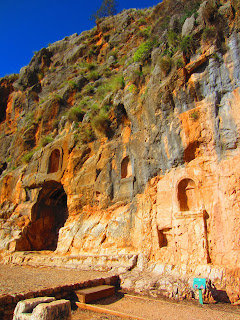 Caesarea Phillipi: You have probably heard in a homily that Peter’s great profession of faith, and his renaming, took place in front of an impressive rock cliff, which is why Jesus is talking so much about rocks. True enough. But did you know that built into that cliff were multiple pagan temples, one of which featured infant sacrifice? When Jesus asks “Who do people/you say that I am?” there are a few different options available to the Apostles: Pan. Zeus. Caesar. Nimrod. All these “churches” are built into the rock. But Peter chooses wisely. Jesus is not a demigod, or even a prophet to be honored. He is “the Holy One of God”. It is on this profession of faith, of which Peter and his successors are the guardians, that Christ has built His Church. As long as we proclaim Christ, and Christ alone, as Lord, the gates of Hell and the forces of evil cannot withstand us.

St. Mary Magdalene, pray for us!


Monday, February 15, 2016
Rest on the Sea of Galilee
Today was a beautiful day around the Sea of Galilee with incredible warm, 60-degree weather. We visited The Church of the Multiplication of the Loaves and Fish in Tabgah. We had the opportunity to attend mass there in the German language with the Benedictine monks. According to ancient tradition this was the spot that Jesus fed the multitudes with 5 loaves of bread and two fish (Mathew 14:13-21; Mark 6:30-46). Our guide pointed out that the 12 baskets gathered from the left overs signified the 12 tribes of Israel being the first to be called by Jesus.

We also visited the Church of the Primacy of St. Peter (John 21:15,17). This is the place where Jesus asked Peter three times, “Do you love me?” Peter responded, “Lord you know that I love you.” Each time Jesus instructed Peter to “Feed my sheep.” We had a long time to pray facing the Sea of Galilee at this spot.

Subscribe to:
Posts (Atom)